If you’ve ever stood at an awards ceremony, stared at a custom trophy, and thought, “That font feels off—this is a one-of-a-kind moment, why is the text generic?” you’re not alone. For 12 years, I’ve run a custom trophy supplier, and one of the most frequent questions I hear, after “Can I get a custom size?” and “What materials hold up outdoors?”, is: “Can I get a custom trophy with a specific font?” Custom Trophy
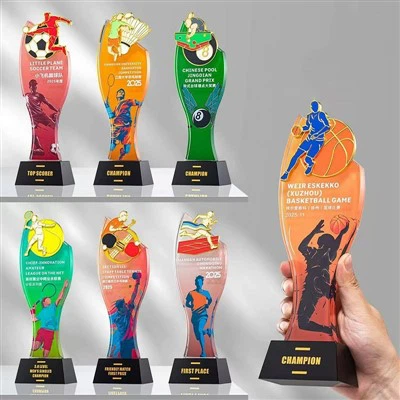
The short answer is yes—no “one-size-fits-all” restriction here. But let’s break down why that’s possible, where people run into common hiccups, and how you can turn that specific font you’ve been obsessing over into a trophy that feels made just for your achievement. This isn’t just a decorative choice; it’s about tying the award’s meaning directly to the moment it’s celebrating.
First, let’s clarify what “custom font” actually means for a trophy, because that’s where a lot of confusion starts. Some clients think they need an entirely original, never-before-seen typeface, which is a whole different (and way pricier) process. More often, they have a specific font they already love—maybe it’s the same one used on a company’s marketing materials for a 10-year anniversary, or it’s the handwritten-style font their daughter used for her science fair poster. Either way, that’s totally doable.
Here’s the science part: when we add text to a trophy, whether it’s engraved (for metal or wood) or printed (for acrylic or resin), the process relies on vector graphics. A font, at its core, is a set of vector files—each letter is a mathematical formula that defines its shape, not a pixelated image. That means if your specific font exists as a vector file, it can be easily adapted to any trophy shape, size, and surface. The tricky part comes when someone only has a raster version of the font—like a screenshot of their favorite script font from Google Fonts, saved as a JPG or PNG. Raster files are made of pixels, so when you scale them up to fit a large trophy, they get blurry. That’s a common mistake, but it’s fixable.
Over the years, I’ve walked through hundreds of font requests: a local high school’s cross-country team wanted the same bold, blocky font used on their team jerseys engraved on the 1st place trophy; a non-profit wanted a handwritten script that matched the founder’s signature for their volunteer of the year award; a tech startup wanted a custom geometric font they used for their product branding laser-engraved on acrylic trophies for their launch team. I once had a client who wanted a font pulled from a 1950s movie poster for their employee 50-year service awards—they sent a grainy photo from a vintage film, and our design team was able to digitize it into a clean vector that worked perfectly on metal.
Let’s talk about the materials, because font choice pairs with what your trophy is made of. Engraving depth, line weight, and even curvature on the trophy surface matter. For example, if you’re going with a thin, delicate script font and a wooden trophy, a shallow engraving will make the letters hard to read. We adjust by deepening the engraving slightly, but only enough that it doesn’t chip or look uneven. For metal trophies, laser engraving can actually etch the font directly into the surface, and we can match even the most intricate serifs or flourishes without distortion. Acrylic is another popular option for custom fonts—you can even do a reverse engraving, where the font is carved into the back of the acrylic, so it looks like it’s glowing from the front, which works beautifully with modern sans-serif fonts.
One thing I always advise clients to do before locking in a specific font is to test it at scale. A font that looks great on a 100-word Instagram graphic might not translate to a trophy that’s 6 inches wide. We regularly create digital proofs before production, so you can see exactly how your chosen font will look on the actual trophy shape. That’s not a random step—it’s based on years of learning that a font that feels too “fussy” at small sizes can become unreadable on a large trophy. I had a client a few years back who wanted a super decorative font with lots of loops and swirls—we made a proof, and when they saw it, they realized the swirls were blending together on the 8-inch trophy. We adjusted the letter spacing and simplified the flourishes just enough to keep the font’s personality, but make it readable from across a room.
Another common question: can I use a font I downloaded online? Short answer: as long as it’s a free, commercial-use font (no copyright restrictions) or you have a valid license for it, absolutely. We’ve used everything from open-source fonts to premium paid fonts, and even fonts that clients have created themselves for their brand. The key here is copyright—if you’re using a font that’s only for personal use, or from a source that doesn’t allow commercial reproduction, we can’t use it. That’s a legal thing, not a personal preference, so I always make sure to mention that upfront to avoid any missteps.
What about custom hand lettering, not just a pre-existing font? Some clients come to us with a handwritten note, a sketch of a logo, or even a signature they want turned into text on a trophy. We can digitize that too, but it’s a bit more work. Hand lettering has natural variations—one letter might be slightly taller than the next, there might be a small smudge in the signature—so we need to smooth those out just enough to make it look polished, but keep the authentic, personal feel. Last year, a family came to us wanting trophies for their kids’ baseball league, and they wanted the text to match their late dad’s handwriting, who had run the league for 30 years. We scanned a sample of his handwriting, cleaned up the lines, and turned it into a vector that we engraved on wooden trophies. That’s the kind of custom touch that makes a trophy mean more than just a prize.
I should also mention that when you’re working with a specific font, it’s important to think about the trophy’s aesthetic overall. A bold, heavy slab serif font works great for a tough athletic trophy, but might feel out of place for a elegant achievement award for a literary contest. That’s where our design team comes in—we don’t just plug in a font and call it done. We’ll suggest adjustments if the font you chose isn’t the best fit for the occasion, without pushing you to go with something generic. For example, if a client wanted a super thin, whimsical font for a corporate sales trophy, we’d point out that the thin letters might scratch easily if the trophy is carried around, and suggest a slightly thicker weight of the same font that would hold up better.
Now, let’s talk about the process from start to finish, to make it feel real. When a client reaches out asking about a custom font, here’s what happens: first, they send us the font file (or a photo/screenshot if they don’t have a file). If it’s a raster file, our design team will trace it to turn it into a vector, which takes about 10-15 minutes for a simple font, a bit longer for a detailed one. Next, we create a digital proof of the trophy, with the chosen font, the size, and the material they selected. We send that proof for approval, and once they say it looks good, we move to production. For engraving, that’s a matter of minutes on the laser machine; for printed acrylic or resin, we use high-quality inks that match the font’s color exactly. Most custom trophy orders with a specific font take about 3-5 business days once the proof is approved, which is fast for custom work, because we’ve streamlined the process over the years.
I’ve seen how a custom font can make a trophy feel like more than just a piece of metal or wood. A employee who gets a trophy with the company’s unique font will hold onto it longer, because it’s a reminder of their specific role and the company they care about. A student who gets a trophy with their school’s exact font will display it on their desk instead of hiding it in a closet, because it’s tied to their school pride. That’s why I care so much about getting the font right—it’s not just a design detail, it’s a way to make that moment meaningful for the person receiving the award.
I know that a lot of trophy companies will tell you that “custom font” is an extra cost, and in some cases, it is—if you need to digitize a handwritten font or trace a low-resolution image, there’s a small design fee, but it’s minimal, and we always explain that upfront so there are no surprises. We don’t mark it up just because it’s custom; we price it based on the time it takes, which is usually less than $20 for a simple font, way less than ordering from a big national chain.
If you’ve been hesitating to ask for that specific font, or thinking that custom fonts are only for big budgets, let me assure you: it’s totally doable, and it’s worth it. The last thing you want is to give an award that feels like every other trophy, with a generic font that doesn’t match the moment. Whether you’re ordering a single trophy for a local club or bulk trophies for a company event, we can work with you to make sure the font is exactly what you want.

If you’re ready to turn that specific font into a custom trophy, reach out to our team to discuss your project. We’ll walk you through every step, answer any questions, and make sure the final product is something you (and the person receiving it) will be proud of.
Crystal Trophy References:
- Adobe Inc. "What Are Vector Files?" Adobe Help Center.
- PrintOS. "Font Considerations for Engraved Products." Roland DGA Corporation.
- The Font Bureau. "Copyright Guidelines for Commercial Font Use." Font Bureau, Inc.
- Woodworking Network. "Engraving Fonts: Best Practices for Readability and Durability." Canadian Woodworking & Home Improvement.
Pujiang County Hongxin E-commerce Co., Ltd.
Address: No. 6, Row 4, Section 4, Yuequan West Road, Pujiang
E-mail: hongjiangluo95@gmail.com
WebSite: https://www.crystalcraftfactory.com/
